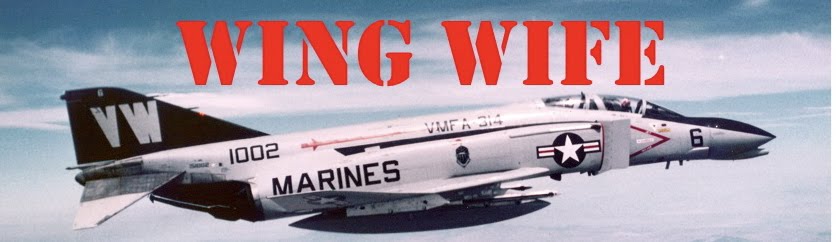
HOW TO BE MARRIED TO A MARINE FIGHTER PILOT--A Marine Corps pilot's wife: F-4s, F/A-18s and aviators from my perspective.

Friday, February 25, 2011

I Know Him Too Well


He’s never invited to our table, on base, in housing, with the kids.
He is not welcome to knock on my door, nor my neighbors’ doors
Nor my friends’, nor wanted on a visit to anyone I know.

Yet he sneaks in anyway
Or blows in on a scrap of paper
Or on the evening news
Or in a chance phone call
An email
And he still knocks with the fist of the uniformed
The warm hand of a rabbi, priest, pastor.

Dear God. No.

If he announces his visit ahead of time,
We fight like muddy Marines in trenches,
Like top guns on ACMs over the Mekong,
Like sailors refusing to give up the ship,
We struggle to our last breath
To prevent him overrunning our position.

He dresses in flames and blood, sometimes in mystery
Often in black as tears or red as sobs or gray as grief.

I try not to think of him.
I never remember when he ends his visit.
Even when he has come and gone, he lingers.
And his specter follows me all the days of my life.

When my guy goes out the door,
He sits with me
With the ghosts he came for, before.

Tuesday, February 22, 2011

Aviator Brief XXI: Dark Waters #2

What could go wrong, would go wrong, and ejections were no exception. Jack Hartman on the USS Saratoga was on the catapult to launch. The bridle connecting his jet to the cat broke on one side and the catapult flung him and the plane from zero to two hundred miles per hour in six seconds--twisted sideways with one wing forward. He knew the plane would never fly, so he ejected.

His plane crashed in front of the carrier.

He floated down to the sea surface directly in front of the bow of the ship going twenty-five knots. The aircraft carrier ran over him. The last thing he remembered while underwater was the sound of the screws, with blades twice the size of a Volkswagen. No one could figure out how he was spat out by the wash without the parachute or parachute cords tangling in the blades.

It wasn’t always enough to be good--sometimes an aviator had to be lucky.

What could go wrong, would go wrong. Yep. My life resembled that.

Give Andy a cross-country or a TDY or send him overseas and that was when the car wouldn’t start and our dog would bite me trying to get through me to the tow truck driver. Thank goodness for neighbors to drive me to the hospital to have my artery repaired--and clean up the half inch of blood in the entryway while my three little girls watched with wide eyes.

Three weeks into his year overseas, I’d discover I was pregnant with our second child--and then six months into the pregnancy, I was put on bed rest for two and a half months. Have you ever tried being on bed rest with a two year old? What could I do? I called my mom. Thank you, Mom. My mom didn’t wrap my two year old in duct tape and I didn’t wrap my mother in duct tape either--though we were both tempted. What do women do without a mom close by and willing to put their life on hold for months on end?

He left one weekend and my cat fell off the headboard of our bed on to my face and I drove myself to the ER holding a pad over my eye to hold my upper eyelid together.

Ask any spouse with a partner in the military and I bet they have stories of their significant other gone and things gone wrong. What did we do when that happened? We dealt with what we had to deal with. We asked for help from the other people in our lives. We hoped we’d survive even when we were deep underwater and heard the screws turning.

Saturday, February 19, 2011

Liar

Military Writer’s Society of America has an award each month called The William E. Mayer Prize for Literary and Artistic Excellence. I thought I’d give it a shot back in December. The word prompt was “Deceit”. Sometimes I struggle with my writing. This wrote itself from my heart.
    
I wanted to marry my love. I had no intention of marrying the Marine Corps--so love mixes with anger and anguish.
        
I’m still glad I married my guy--now 36 years! I’m so proud of him and so proud to be a Marine’s wife. That doesn’t mean I don’t remember being mad about it all.

LIAR

You lied. 

Even the uniform all starched,
And pressed with red stripe
For the blood of others,
While you promised forever,
In sickness and in health. 

True blue. 
Honor. 
Leadership.
You led me down the path
Of believing while I
Scattered rosebuds where I may. 

No more.
Only Decembers and Januaries
Gripped by cold.
Gripped in cold empty arms.
My white knuckles tighten. 

You take up arms,
You swore,
To hold me in your arms.
Gunmetal arms, mortars, bullets,
Rotors and turbine jet engines,
Take you from me.

I swear. 
I have issues with
Not being issued,
Being left behind
With our children
Who cry
Their worry. 
I worry. 

We miss you.
I miss you. 
Come home.

Tuesday, February 15, 2011

Aviation Brief XXI: Dark Waters #1

An A-4 pilot flying out of Iwakuni, Japan had a night hop over the Sea of Japan. Next thing he knew he was being picked up out the freezing water by SAR--Search and Rescue. He remembered nothing of a crash or ejection, but his plane had disappeared. Pilots hate mysteries. What they don’t know can, and often has, killed them or others. With any accident, there is an Accident Investigation to figure out the cause of the mishap.

 In an unusual step, they had the pilot hypnotized. Under hypnosis, he remembered going to join up on lights below him, but instead of his wingman’s lights, they must have been reflections on the water. His plane flew into the sea before he realized he needed to eject. He came to, in absolute Stygian darkness, in a cockpit filling with icy water. He tried to manually open the canopy, but the pressure outside wouldn’t allow it. The ejection handle wouldn’t have helped; the water would have held the canopy on and he would have been rocketed into the plexiglass. So he waited in the black cold until the cockpit filled, then he opened the canopy and swam up to the surface, one hundred feet above the plane. He kept his cool to live to fly another day.

Some days I feel like I’ve crashed into a night ocean and I’d do anything to find my way to the surface--any surface. The glimmers of light I followed had fooled my heart to believe everything would be okay if I just continued on my present course and joined up with the others going my way. Or who I thought were going my way.

To carry the metaphor further--it’s dark down here. Dark and cold. And there is so much pressure from outside forces to stay where I am but if I do, I know I’ll die. Panic wants me to claw the canopy bloody, or pull an ejection handle that would rocket me into unforgiving plexiglass.

Sometimes we have to wait out the worst of circumstances until we can do something to change where we are in life. Whether it is with a spouse, a friend, a boss, or life’s circumstances, we can’t control everything but we can control how we react to the dark, cold waters. Then, once the cockpit fills up and we can slide the canopy off, we have to swim to the surface and inflate our personal survival raft.

Thursday, February 3, 2011

Aviator Brief XX: Quick Change #3


When the Change of Command ceremony was held without a marching band or printed programs, presided over by the frown of the Group Commander, and with the outgoing CO conspicuously absent, did Duke Lynne, the brand new CO, feel any need to knock wood, cross his fingers, or light a candle in the base chapel?

Duke had been on the schedule to fly well before the emergency change in squadron leadership. What better way to celebrate, or mourn the ouster of a friend, than to launch into the sky? The flight of two prepared to take off on their briefed, low-level navigation mission. Unfortunately, Duke’s plane did not cooperate in the celebration. It broke in the chocks seriously enough that Duke and the plane were grounded.

The FNG pilot in the other plane asked if he could continue, flying the briefed mission solo. Duke saw no reason both should suffer from his bad luck. He cautioned the new lieutenant, on the radio, to stay above 5000 feet--although the original brief had been down to 1300 feet above ground level.

Perhaps the radio was broken, too.

The FNG lieutenant returned and landed--miraculously--at MCAS El Toro in an A-4 that had its canopy and tail sawn almost in half by 90 to 100 feet of high tension wire. No ceremony was held for Duke’s ouster.

His tenure as a CO? Six hours.

Sometimes shit happens through no fault of our own. In the Corps, the final responsibility rests with the Commanding Officer. I hope Duke went on to live a long and happy life regardless of his tenure as a CO of a squadron.

I know I have not been a perfect wife or an infallible mother. I wish I could have been better at either task. But no one gave me a training manual! I never had the equivalent of carrier quals. Flying the ball in a marriage with teenage daughters is landing without an LSO, the ball, or a hook on a pitching deck in a howling gale at night.

So I am working on accepting that I did the best I could--just as my dysfunctional parents did the best they could. Each day I try to make the world a bit better for someone else. I can’t fix what I did. I can live each day forward while hoping I am not trailing high tension lines.

Wednesday, January 12, 2011

Aviation Brief XX: Quick Change #2

The new CO of the squadron, Tim Dineen, a good stick and a good guy, flew an A-4 plane with a high time engine which should have been in overhaul. Engines were required to be reworked every certain numbers of hours. A ten-percent flex was built-in just in case a plane was on a cross-country when the maximum threshold had been reached. Col. Dineen flew a plane well past the flex hours, and then ran out of luck when the over-the-maximum-threshold engine quit, he had to eject, and then was ejected from his command.
 
They held the Change of Command ceremony the next morning in the Group CO’s office, without a marching band or printed programs, presided over by the frown of the Group Commander, and with the outgoing CO conspicuously absent.

I am so thankful that Col. Tim Dineen ejected safely when his luck ran out. And it reminds me that there are reasons for rules on maintenance.

There are also certain rules for maintenance of a marriage. Some of them remind me of the fighter pilot rules of life. One of the jobs of the fighter pilot in air combat maneuvers is to learn the techniques for neutral, defensive and offensive starts--when no plane starts with an advantage, or when the bogey or the ‘good guy’ starts with an advantage.

Marriage shouldn’t be about offense or defense--except when we defend our spouse against all enemies foreign and domestic. Marriage is about establishing common ground--neutral starts. What do we have in common? How can we get where we want to be? Who is that person I’m flying through life with and how can I help him/her be the best they can be? We need to help each other watch out for bogeys and avoid clouds full of rocks.

May all our marriages make it home without ejections, without changes of command.

Wednesday, January 5, 2011

Aviator Brief XX: Quick Change #1


One A-4 squadron must hold the record for the most Changes of Command in the shortest period of time--three in six months. Generally, a CO’s tenure lasted from a year to two years. Getting fired short of a year required fucking up enough that the Group CO announced he had ‘lost confidence in the ability of the squadron CO to lead.’ Some men spoke seriously of falling on their swords when faced with such a scenario. They’d rather be dead than look bad.

The first hapless CO flew into Lemoore NAS. Wanting to show the Navy that the Marines had the right stuff, he brought his flight of four overhead in a flashy, yet frowned upon, fan break-where all the planes rolled together toward the runway. Unfortunately, in concentrating on looking good, the CO neglected to deploy his landing gear before touching the aircraft down on the runway. The plane ground to a halt in a shower of sparks and crunched plane parts.


A Change of Command Ceremony was hastily arranged with a band and printed programs.

The First Fighter Pilot Rule For Life: Keep your S/A--Situational Awareness.

I need to know who I am. It is also important to know where I am and know where I am in relation to others and other things around us. This CO didn’t keep his mind focused on his immediate now. The future is created from the now of my life. If I do all I can now to be awake to this moment then my future might unfold as I envision.

I say might because, well with the best of intentions, shit happens. But if I am here and now, I can also abort a foolish, doomed landing and live to fly another day.

Are you here? Have you tried to land unprepared?

Wednesday, December 29, 2010

Aviator Brief XIX: Flying At Any Cost


Maintenance officers appreciated pilots who got a plane home to be worked on. If it could be flown safely--fly it. Some weak dick pilots and RIOs downed their ride for every little hydraulic fuel leak. Phantoms were elderly planes--they all leaked a little bit. Get some balls, fergodssake.

An FNG lieutenant in VMFA 314 didn’t like causing trouble for his AMO--Aircraft Maintenance Officer. So, on a refueling stop in Yuma, one leg away from home base, frustrated when the F-4 wouldn’t accept external electrical power from the starter, he decided to try a non-standard procedure, principally used for testing the RAT--ram air turbine, in order to get going. In the non-standard procedure, high-pressure air is directed at the RAT, which spins into operation, providing power. The lieutenant deployed the RAT, and standing on the wing, held the nozzle of the hose from his Wells Air Starting Unit.

The pilot intended to guide high-pressure air from the hose across the blades of the RAT. The RAT would spin and produce enough power to light off his fighter.

Fast-moving air charged through the hose to the nozzle.

Unfortunately, back-pressure on the hose caused it to thrash about wildly. The hapless lieutenant, flying twenty to thirty feet in the air, whipped back and forth, held on as long as he could before being tossed to the concrete below.

Medical personnel needed over a hundred stitches to close up the deep three-inch gash on the lieutenant’s arm.

He lived to make general--and to be a credit to the Marine Corps.

Ignorance was temporary, unless it proved fatal.

Redemption comes if the lesson is learned. The lieutenant had his story told in Granpaw Pettibone--a safety cautionary column in Approach magazine. The theory being that aviators can learn from others’ mistakes and prevent further injury or loss of valuable equipment. Andy always talks of the aviator as one of the more expensive pieces of equipment the service has. In 1970 it cost 1.5 million to train a fighter pilot. Nowadays it is more, probably a lot more. If you add in the time it takes for OCS through flight training--the military can’t afford to lose personnel.

All of that is an accountant’s view of aircraft mishaps and reasons to prevent them.

On the other hand, I know how many people are affected by the loss of a single person.

I dreamt of my older brother Don last night. Sunday will be the 31st year since he died in a midair. In my dream, he walked into a room where I spoke with other writers about writing and publishing and marketing. He was so big and full of life. He grinned and said, “Hi guys!” I was so very glad to see him.

Many things would be different if his plane hadn’t run into the same piece of sky as another. His loss changed my family dynamics and exposed so much of the dysfunction of my childhood.

As the New Year begins, I need to look at the costs of my own mishaps and learn my lessons so they are not repeated, so I don’t crash and burn leaving sadness and regret in the ashes.

What mistakes have you made that you need to learn from?

Saturday, December 18, 2010

Christmas SOP


The following was sent to me by MSgt Ben Spotts. Tis the season for all kinds of orders :)

To:      ALCON

Subj:   Christmas SOP

Ref:    (a) OPLAN 360-04 (North Pole) of 4 DEC

1.  Per the reference, an official staff visit by LtGen Claus is expected at your house on or about 25 DEC.   The following instructions will govern the activities of ALCON during the visit.

     a.  Not a creature will stir without permission.  This includes Warrant Officers and mice.  Marines may obtain special stirring permission for necessary administrative action through DPAC.  Officer stirring permits must be obtained through the XO.

     b.  All personnel will settle their brains for a long winter nap NLT 2200, 24 DEC.  Nap Uniform will be: Pajamas, Cotton, Light Weight, General Purpose, OD, and Watch Cap, Wool, Black.  Equipment will be drawn from Supply prior to 2130.  While at Supply, all personnel will review their ECR card and sign a checkage (DD Form 1131) for all missing items (remember, this is the "season of giving.")

     c.  Personnel will utilize standard MRE sugar plums for visions to dance through their heads.  MRE ration pack sugar plums should be eaten with egg loaf, chopped ham, and spice cake to ensure max visions are experienced.

     d.  Stockings, Wool, Cushion Sole, will be hung by the chimneys with care.  Officers will conduct ORM to ensure the necessary safety precautions are taken to avoid fires caused by carelessly hung stockings.  Stocking handling plans will be submitted to the S-3 (Training) prior to 0800, 24 DEC.  All SNCOs will ensure their subordinates are thoroughly briefed on the safety aspects of stocking hanging.

     e.  At the first sign of clatter, all personnel will spring from their beds to investigate and evaluate the cause. Immediate action will be taken to tear open the shutters and throw up the window sashes.  On order, para 6-8 (c)(3) of the reference takes effect governing shutter tearing and sash throwing.  SNCOs and NCOs will be familiar with
procedures and are responsible for seeing that no shutters are torn or sashes thrown prior to the start of official clatter.

     f.  Prior to 0001, 25 DEC, all personnel possessing binoculars and night vision equipment will be assigned "wandering eyeball" stations.  SNCOs will ensure these stations are adequately manned even after shutters are torn and sashes are thrown.

     g.  The S-4, via the Motor Pool, will assign one (1) Sleigh, Miniature, M-24 and eight (8) reindeer, tiny, for use by LtGen Claus. The assigned driver must have a current sleigh operator's license with roof-top permit and evidence of attendance at the winter driving class stamped on his DD Form 348.  The driver must also be able to clearly
shout "On Dancer, On Prancer, etc."

2.  LtGen Claus will initially enter the CP via the CDO.

3.  All houses without chimneys will draw one (1) Chimney Simulator, M6A2 for use during the visit.  Draw chimney simulators as necessary via a DD Form 2765-1, which will be submitted in four (4) copies to the S-4 prior to 23 DEC.  Chimney simulators must be properly cleaned before turn-in at the conclusion of visit.

4.  All SNCOs and NCOs will be rehearsed in the shouting of "Merry Christmas To All and To All a Good Night."  This shout will be given upon termination of the visit.  Uniformity of shouting is the responsibility of the Officers.

Semper Fidelis,

U. B. GOODE

Fideli Certa Merces
"To The Faithful There Is Just Reward"